Tuesday, 13 January 2015

Understanding the Film & Tv industry: Task 2

In this blog I will explain what the different job roles are in three different sectors. The sectors that I will talk about are creative, managerial, and technical job roles. I will go through these and explain all of the different roles and responsibilities of the people who do this job. I will also try and give one example of a person working in this sector.


The job that i would like is director I will talk about that job and how I will get there. I have done this in the director section. I have talked about the path that ill need to take to achieve my goal.
Producer
I will start by talking about managerial jobs and one of the more important roles is the role of producer. The producer is seen as the leader of the team and their job is to organise and manage the production from the start to the finish. Also the producer is the first member of the team.
A producer can come from many parts of the industry as they can be an investor, writer, director or even an actor. The lead producer is known as an executive producer and this can be an actor who would work as an actor and would work on the project with the producer from start to finish.
In pre-production, Producers bring together the key members of the creative team. This includes the Director, Cinematographer and Production Designer and key cast members. They help the Executive Producers to raise money for the production. Producers also approve locations, studio hire, the final shooting script, production schedule and budget. More time and money spent in pre-production can reduce time and money wasting when the production gets underway.
Once the film is in production, Producers are responsible for the day-to-day smooth operation of the team. Producers are also in constant communication and consultation with the Director and other key creative, on and off set. Producers approve all script changes and cost reports. They are the first point of contact for all production partners, investors and distributors.
During post production, Producers are expected to liaise with the Director and post production department. The Producer will deal with the finance and distribution companies in planning the marketing and distribution of the finished film.
The skills that a budding producer would need to have are; being a good business person, having good interpersonal skills, having an eye for good ideas and being able to work under pressure.
The example I have chosen for the producer is Steven Spielberg. Although famed for being one of the biggest movie directors of our time. Spielberg also produces film too with titles including Jurassic Park, Men in black and Transformers.
To become a producer you should get started in the Production Office it is worth getting experience as a Production Assistant or Runner. If you can prove that you are reliable, trustworthy and enthusiastic you may progress.
Steven Spielberg

Assistant producer/ Associate producer
After the producer there is also the assistant producer/associate producer who will work closely with the producer and will ‘cover’ for the producer and executive producer in pre-production, the actual production itself and post production.

Associate Producers are usually individuals within production companies who have played a significant role in the development of the script or screenplay. The term Associate Producer is also sometimes used to describe a Producer from a smaller production company which is co-producing the film. They may have risen some funding for the project, but not enough to get an Executive Producer or Co-Producer credit.

Associate Producers take on responsibilities delegated to them by the Producer. They work on the development and pre-production stages, and on the production. Duties can range from supervising the production design team or post production, or coordinating the work of visual effects companies.
An example of an assistant producer is Charles Song who is American and has worked on shows such as Family Guy, American Dad and The Simpsons.  
The role of Assistant Producer is varied, so you can come from a range of backgrounds within the film industry. You can start out as a senior Script Editor, Production Manager or Post Production Supervisor and use your specific experience as an Assistant Producer. But as with many jobs in this industry it’s usual to start as a runner and work your way up through the tree from the there.

Executive Producers
Executive Producers are responsible for the overall quality control and success of TV productions, and for ensuring that final products conform to commissioners' specifications.

They are part of the team who are responsible for selecting marketable projects and ensuring that every step is taken to guarantee success in the market. They lead the production of a range of television programs, including dramas, serial dramas,
documentaries and drama documentaries.
Executive Producers' roles vary depending on the genre, broadcaster or production. They must be able to identify commercial, marketable projects from a range of proposals. They may help to develop scripts. They are responsible for finding suitable markets for projects.
The cost of a television production may be shared amongst a number of partner organizations who will all eventually broadcast the finished programs. They ensure that a range of publicity and marketing materials are prepared in order to attract co-production partnerships and funding.
During production Executive Producers may act as a sounding board for Producers in the decision-making processes. They may be involved in some aspects of scripting, casting, and/or crewing. In the role of Executive Producer, the executive producer may perform a dual role on productions, such as Writer and Executive Producer.

To be an executive producer you should have; highly effective negotiating skills to be able to get the production done for the least amount of money. They must understand current audience requirements and what is getting the biggest audiences so they can make an educated decision as to what I getting the best ratings.

An example of an executive producer is Chuck Lorre who is American and is responsible for giving America and Britain some its biggest sitcoms such as Two and a half men, the Big Bang Theory and Mike and Molly. He has been in the business since 1984 and has a real understanding of how the world of making a good and successful comedy show works, proof of this is that he has been nominated for 8 Emmys and has had 9 other wins and 15 nominations.

You will normally need to establish yourself as a Producer who is able to bring money to a project. You could also move from another background as a distributor, Sales Agent or financier. There are other ways to be a producer from other sectors such as director or actor.
Chuck Lorre


Line Producer
The Line Producer is one of the first people to be employed on a film's production by the Producer and Executive Producers. They are in charge of all the business aspects of the production of films. During pre-production, Line Producers work with the Director, Production Manager, First Assistant Director, Art Director and other Heads of Department. They prepare the production schedule and budget, and to set the shoot date.

During production, Line Producers hand over control of the final budget to the Production Accountant. They delegate the day-to-day operation of the production office to the Production Manager and Production Co-coordinator. However, Line Producers are ultimately responsible for overseeing everything and making sure the production is completed on time and within budget.

They set up and implement financial monitoring systems, controlling production expenditure, controlling production materials, and monitoring and controlling the progress of productions. Line Producers usually cater for unforeseen circumstances, and spend much of their time juggling figures and resources.

Line Producers are responsible for certain health and safety procedures, and for sorting out any insurance claims. At the end of the shoot, the Line Producer oversees the 'wrap’ or winding down, of the production.

Line Producers are usually employed on a freelance basis. They work long hours, though the role is well paid. If a Line Producer has a creative input, he or she is often credited as a Co-producer.

You can usually progress to the role of Line Producer by working your way through a variety of roles in assistant direction, location management and/or the production office. Many start their careers as Runners or Production Assistants. Line Producers must also attend the required health and safety courses.


I will now move onto the creative job roles which required a whole different set of skills that to managerial job roles. The job that I’ve chosen to cover is in the directing sector.

Director
This is the job that i would like to undertake in the future and i will show how to achieve the stature and position of director.. The director is the creative force behind a production and I one of the few people on a production who can give it a personal touch. The director has the job of carrying out duties such as casting, script editing, shot composition, shot selection and editing.
 
The Director is ‘top dog’ as far as directors are concerned being the director is as high you can possibly get. During pre-production, Directors make crucial decisions, such as selecting the right cast, crew and locations for the film. They then direct rehearsals and the performances of the actors once the film is in production.
They also manage the technical aspects of filming including the camera, sound, lighting, design and special effects departments. During post production, Directors work closely with Editors through the many technical processes of editing, to reach the final cut or version of the film.
At all stages, Directors are responsible for motivating the team to produce the best possible results. Directors must also always be aware of the constraints of the film's budget and schedule and manage the expectations of the film's financiers. You don’t need a formal qualification to become a Director.
However, the role can only really be mastered through in-depth practical experience. You will find writing a screenplay, directing your own short film or an amateur play is all good starting places.
You will also need extensive industry experience; up-to-date knowledge of film making techniques and equipment is vital, as is learning how to work with actors to create a performance.
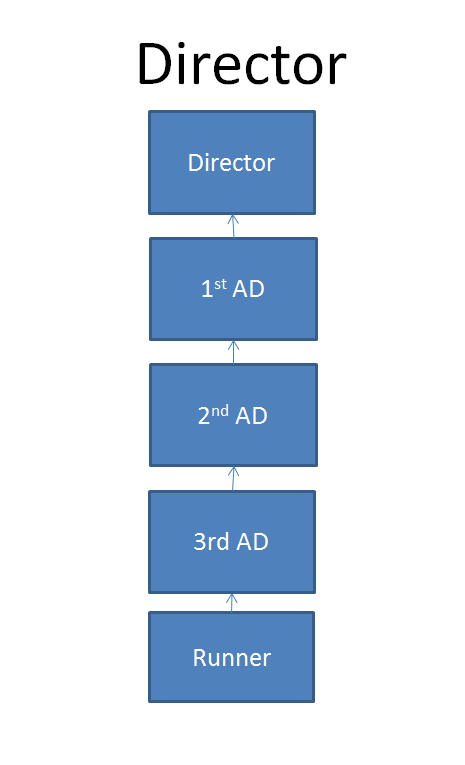
The ideal way to get into this job is to start as a runner and then work your way up through the roles of 3rd, 2nd and 1st assistant director. It is also advised that your produce your own work in this subject such as short films, plays and record live stage shows such as bands, and other live performances.
An example of a famous director is Ron Howard who has worked on productions such as Apollo 13, Rush and A Beautiful Mind. During his time as a director Ron Howard has picked up 2 Oscars, and has had 32 wins from other awards and also got 60 nominations for awards. There are many more examples that i can choose from and they include people such as Wes Anderson, Tom Hooper and James Cameron.
Ron Howard

1st Assistant director
The first assistant’s director’s job is being the Director's right-hand person, taking responsibility for a number of important jobs so that the Director is free to concentrate on the creative process.
Before the shoot, the Firsts' main task is to create the filming schedule, working in careful consultation with the Director.  When drawing up the shooting schedule, First ADs must also be aware of the budget, cast availability and script coverage. 
First ADs' main duties are assisting the Director, coordinating all production activity, and supervising the cast and crew.  They are also in charge of a department of other Assistant Directors and Runners. Overall, they provide the key link between the Director, cast and crew, whilst also liaising with the production office, and providing regular progress reports about the shoot.
Preparing the storyboard, overseeing the hiring of locations, props and equipment and checking weather reports are all key pre-production duties for Firsts.  Firsts are also responsible for health and safety on set or location, and must take action to eliminate or minimise hazards.
Some of the first assistant director’s responsibilities include preparing the storyboard, overseeing the hiring of locations, props and equipment and checking weather reports are all key pre-production duties for Firsts. 
There are many ways in which you can become a first assistant director you can expect to start your career by getting work experience as a Runner on a film set or in a production office before working your way up through Third Assistant Director and Second Assistant Director.
 
2nd Assistant Director
The job of the second assistant director is to be the First Assistant Director's right-hand person. Preparing and drawing up the 'call sheet' to make all of your crew and cast get to a location on time and to the right place. Overseeing the cast, ensuring that the principal Actors are in make-up, in wardrobe, or standing by on the set at the correct times.
The Second AD's main function is to ensure that all of the First AD's orders and directions are carried out. On each day of a shoot, Seconds must prepare and draw up the next day's call sheet, (which involves confirming the details of who needs to be on set and at what time, the transport arrangements, extras required etc.). These details must be approved by the production office before the Seconds can distribute the call sheet to the cast and crew.

3rd assistant director
One of the first roles of a third assistant director is supporting the First and Second ADs on the set or location. They may have to direct extras or vehicles appearing in the background of the shot, especially in large crowd scenes. They will act as a sort of link between the first and second assistants by conveying messages and relaying information to cast or crew on the set or location, usually by radio link.

To do this role, you will need to have excellent organisational and time-management skills and also you will need to have common sense and initiative to carry out all responsibilities forwarded to you by the first and second assistants. They will also have to take and carry out instructions with enthusiasm and efficiency and be diplomatic and patient when coordinating and directing large groups of extras. They will also need to be highly motivated and have good communication skills while working with actors and extras. They will also need to work effectively under pressure and make sure that the film runs smoothly. You will also need to know the necessary health and safety skills needed for any accidents that may occur on set or location.

The main function of the Third Assistant Director is to manage the movement and activities of background artists (extras). Thirds co-ordinate the extras to arrive at the right time and place for filming. Once the extras are on set or location, Thirds prepare and cue them, and sometimes also direct them in any required background action.

They must also supervise and look after the extras – they may be on standby on the set or location all day, despite only being needed for a short period. Thirds may have to keep members of the public out of shot and off the set or location, so that they don't interrupt filming, cast or crew. Thirds may also liaise with the Location Manager, and may be given responsibilities with regard to the security and locking up of studios or locations after filming has taken place.
You can expect to start your career by getting work experience as a Runner on a film set or in a production office before becoming a Third Assistant Director. This role can then take you onto the role of being a second and then first assistant director.

Now I will talk about a technical job role. The job I have chosen to do is editor, and all the roles needed to achieve this job role including assistant editor and runner.


Editors
One of the jobs of an editor is working closely with the Director to craft the finished film. They will also be working in an edit suite for long hours to make sure that the film is finished on time and too a good standard. They will also be running a team of assistants and trainees on big productions that will help with the editing process.

To do this role, you will need to have technical aptitude and have a wide range of experience in the post production process including a good knowledge of different editing software. You will need to know how to create a good storyline in the film although they will be accompanied by the director. They will need to handle the pressure of the tight deadlines that comes with the job. You will also need to understand a narrative and have an imagination for creating a story. You will also need good communication skills within your team and will also need to be able to lead a team. You will also need patience and have incredible attention to detail. You will also need to have good organisational skills to be able to command a team.

Editors are one of the key Heads of Department on feature films, responsible for First Assistant Editors, and on bigger productions, Second Assistants and Trainees. The Editor works closely with the Director, crafting the daily rushes into a coherent whole. To ensure that the story flows effortlessly from beginning to end, each shot is carefully chosen and edited into a series of scenes, which are in turn assembled to create the finished film.

Editors work long, unsociable hours, often under pressure, in an edit suite. They are employed on a freelance basis by the Producer based on their reputation and experience. Editors often work on television drama, as well as on feature films. The Editor works closely with the Director before shooting begins, deciding how to maximise the potential of the screenplay. Editors check the technical standards, as well as the emerging sense of story, and the actors' performances.

Because scenes are shot and edited out of sequence, Editors may work on scenes from the end of the film before those at the beginning, and must therefore be able to maintain a good sense of how the story is unfolding. Editors select the best takes and edit them together to create scenes.

During the post-production period, the Editor and the Director work closely together, refining the assembly edit into the Director's Cut, which must be approved by the Producers, until they achieve picture lock or Fine Cut the film?

Traditionally, you could go from being a Runner to a Trainee, Second Assistant, and First Assistant and eventually to become an Editor. However, with digital editing, 2nd Assistants are now only employed on very big budget films.

As a Trainee with at least two years' experience you would have to work as an Assistant in television or on low budget films for a considerable period of time before becoming First Assistant on feature films. Some big budget productions take on Trainees and Second Assistants, and it is important to keep up to date with films in pre-production by reading the trade press.

If you can work with an Editor as an Assistant, you may be allowed to carry out the assembly edit of some sections of the film. If you can become an experienced Assistant, you may also work as an Editor on short films, which will enable you to showcase your talents.


The example of an editor is Barney Pilling who has worked on films such as the Grand Budapest hotel, Never let me go and Bad Education. Barney has won 1 golden globe, 1 Bafta award along with two other wins and 4 nominations.


Editing assistant
 
Some of the jobs of an editing assistant are running and maintaining editing systems they are also expected taking responsibility for the smooth running of the cutting room on feature films. They will have to be supporting the whole of the post production process on feature films and working closely with film labs, and with the camera and sound departments.

Assistant Editors take charge of the day-to-day running edit suite, leaving the Editor free to concentrate on the work of editing the film. The first task is to communicate with other relevant departments (production, camera, sound, etc.) to understand and analyses the work flow, and to pass this information on to the Editor.

During the shoot, while the Editor starts to work on a rough assembly of selected rushes.
Assistant Editors often work in a different room to the Editor and, on low budget films, may be required to sync rushes early in the morning or late at night when the editing machine is not being used by the Editor. Consequently, the traditional apprenticeship model for Assistant Editors has changed, as less time is now spent watching and learning from the Editor. Assistant Editors must therefore be more proactive in monitoring how the edit is progressing.


Depending on the workload, and providing the Editor trusts the Assistant, whole segments of the assembly edit may be given over to Assistant Editors, who can use this opportunity to demonstrate their flair and ability. When picture lock is achieved, one of the Assistant Editors' last tasks is to compile an Edit Decision List, which provides a record of all the edit points. An assistant editor works like an editor on a free-lance basis and not contacted to a certain company.

Most Assistant Editors start their careers by working as runners on feature films or at editing facilities houses and progress to becoming Trainees, 2nd Assistants and eventually Assistant Editors.

Some big budget productions take on Trainees and Second Assistants, and it is important to keep up to date with films in pre production by reading the trade press. Some Assistants decide not to become Editors, choosing to continue working as Assistants on bigger budget films, which can be equally demanding and rewarding. Some productions will even do a compromise working with contributing editors who may be only needed if the work load is too great or if the production is running behind schedule.


Runner
I have decided to put the part of runner at the end and this is because the job of runner connects all of my chosen jobs as runner is the best place to start the ladder. A runner would be working in the office, around the set and on location and dealing with varied office admin tasks they would also be dealing with a range jobs on locations.

To do this role, you will need to be flexible and well organised and be able to think on your feet to fit the task given to you. You will need to be able to take orders and for that require good communication skills. You need to be organised, punctual and enthusiastic about what you’re doing. You need to work calmly and effectively under pressure. You would need to show a wiliness to learn and be able work without supervision. You would need to be organised.

You don’t need a specific qualification, but a good education is an advantage. You will also need a full, clean EU driving license. Start out by getting some experience in film, drama or broadcasting. It can be in amateur dramatics, student radio or film making, shorts or community media.

Working Patterns

Directors: Directors often work on a freelance basis and reputation counts for a lot and a big reputation can bring in more work. Some directors develop a relationship with producers or companies and this can be almost a guarantee of work in the future. This is the same for 1st, 2nd and 3rd assistant directors who work with certain directors too. The director will work for the whole production because like the producer its thier name and reputation on the line and they have to work hard to make it a success.

Editors: Editors in the film industry are sometimes free lance but can be contracted to companies unlike directors who are rated on previous work and thier reputation. Links and contacts are important to editors too who because they spend a lot of the production with directors are more likely to build a good workign relationship with eachother. For assistant editors, second assistant editors and runners, it can all depend on the head editor or lucky breaks onto whether or not they get work. If they prove they have a talent for this industry then a editor may take them on as a right hand person for future work. Editors will spend most of thier time in post production and barely any in the actual production although thier work load comes in at the end they have to work at the start with the director to help create the film.

Producers: A producer works nonstop through a production with thier staff making sure that the production is on track and money isnt being wasted. They are at the top of the film chain which means that they are all in the postion of hiring and firing the staff on and off set. The producer has to keep a close eye on all staff to make sure that thier production runs smoothly.
 

Bibliography


Thursday, 8 January 2015

Understanding film and TV: Task 1


Unit 8 case study

Technologies

Satellite and cable

Disney is both satellite and cable as it has over 70 million subscribers to the channels in Europe and in the US 89% of households have the Disney channel package. The channels are broadcast worldwide and are broadcast in several different languages including Spanish, English, French and German and many others.

Digital

Disney runs as a digital channel as it is not one of the analogue channels as they are the 5 main channels in the UK including the BBC, ITV, Channel 4 and Channel 5, but Disney is broadcast to the UK via Sky, Virgin, BT or any other providers.

Film based

A huge amount of Disney’s profit comes from film making and their latest film Frozen grossed over 1 billion dollars. Overall since Disney is one of the leading film makers their films are expected to get high gross figures with every release.

Interactive

Disney has many ways to interact with its customers for example they have programs like Disney mobile which is part of the Disney interactive sector and it designs mobile apps, wallpapers, ringtones  and games that children can play with their favourite characters on. The Disney Interactive company, which is a subsidiary of Disney, makes the games and is part of the Disney internet group.  Disney also runs Disney on Ice, which is a Disney tour that goes all the way round the world and gives fans of the movies a chance to see their favourite characters perform their favourite parts from their films.

Internet

Disney has a set sector for dealing with its online activates and they are the Disney Internet group which is a subsidiary of the Disney Corporation.  Disney runs a main website with several links to other websites for example the main Disney website has links to the website for Disney Land and the Disney channel.


Ownership

Private Ownership and Commercial usage

The company is owned privately and by shareholders and a board of directors. The company’s biggest shareholder is Steve Jobs who owns a 7% stake in the company and although dead is still listed on the board of directors. The company CEO is Robert Iger who has been in charge of the company since March 2012 was elected to govern the company by Tim Cook, who now is Apple’s CEO. The Disney Company does not advertise on all of but one of its channels, the odd one out is Disney XD, which mainly advertises children’s toys, but apart from that channel, the other channels advertise other Disney shows, films or products made by Disney. Disney is not a public service, an example of a public service is the BBC because it has no owner and is paid for by the public.

Corporate, global company and monopoly

Disney is a corporation because it is a large company, which acts as a single entirety for example the Disney Animation Company, is sold as part of the main Disney Company. It is also a global company because its products and material are broadcast and distributed worldwide and are sent out through Disney’s distribution arm of its company. As a story, monopoly company Disney does not spend much of its budget on a film paying other film distributors to send it out to the world because they have the power to do it on their own. Disney is not an independent company, and example of an independent company is Paramount who only produces the films but need the help of bigger companies to distribute it around the world. Although Disney is a monopoly, there are other companies that are also oligopolies for example Paramount is an oligopoly because it relies on other companies to help advertise their films.

Vertical and Horizontal integration

Disney is both vertical and horizontal because of the companies that it has bought and taken them under their wing. Disney’s takeover of ESPN would be considered as horizontal integration, as the company does not form a part of the production process of any Disney productions. Its takeover of ABC would be considered as vertical integration, as the TV network forms a place where Disney can broadcast its productions, this is the same as when Disney bough Pixar because they use Pixar to produce and broadcast their material.


Funding

Licensing fees

When a company wants to sell Disney’s products they must first meet a set stand set by the Disney Company, which they must meet, some of these are; the company must have been manufacturing and distributing toys and other related products for at least 5 years and, the company must not be an intermediary. Then once these criteria have been met by the company they must agree to set terms and conditions which also include that Disney will receive 50% of all profit made but will not pay distribution fees and a set amount of money must be agreed at the start of the financial year depending on profit made in the previous year. Viewers of Disney don’t pay a license fee like people in the UK do for the BBC because Disney is a private company that doesn’t run off public funds whereas people pay for the BBC and this means the BBC is funded by the public and belongs to the public.

Subscription and Pay per view

Disney runs several channels and most popular is the Disney channel, which is subscribed to 86% of televisions in the US, which earns the company around $750 million a year. Disney runs subscriptions through Virgin, Sky and BT and they receive a set amount from every fee paid. Disney also runs a pay per view system with the Sky Movies Disney channel and has been known in the past to run it on its Disney channel when a film has premiered on the channel.

Advertising

Last year the Disney Company spent $1.93 billion on advertising worldwide sending advertisements out to over 50 different countries. Although Disney spent a lot on advertisements, they are third in top five film major film studios. Disney’s advertisements on their channels are mainly made up with ads for their own shows and do not plug products. The only Disney channel to play ads is Disney XD and the ads are generally for kid’s toys.  Walt Disney Co. spent $1.93 billion on ads;

       TV: $546 million

       Magazines: $178 million

       Newspapers: $88 million

       Internet: $187 million

       Other: $933 million

*other includes things such as Radio advertisements, billboards, and gaming adverts.

Disney still spends an average of two billion dollars a year worldwide on getting the Disney name hot on the world’s consciousness and to keep the interest in the company high.

Product Placement

Disney tends to product place in its own work, for example in the old animated films Mickey Mouse, Donald duck, Goofy would all make appearances in the background for example they are in the background of Little Mermaid, Snow white, and Cinderella.  Disney also have product placement on films such as Saving Mr Banks. This also links very closely with the fact that Disney is a big believer in self-advertisement and the fact that the company is trying to spare extra expense by keeping the Disney name in people’s heads.

Private Capital

Disney’s whole company is riding on the stock market. This is a good way of bringing in profit because if they take a loss then all of the shareholders take a small hit. This means though when the company earns a profit the profit is shared amongst its shareholders. This is also a great way to merchandise the company with fans wanting to own a part of Disney and this earns Disney and immediate profit. The biggest shareholder of Disney is Steve Jobs who owns 7% of the corporation despite the fact he is no longer alive. The average Disney share price is $40 and then once the fee is paid to Disney the shareholder then would own 0.007% of the company.


Wednesday, 10 December 2014

Production blog for Documentary & Soundtrack Production

Log 1  04/11/2014 - Today i have put everything into order in my production file and labelled all of my plastic wallets and now i know what i need and what i have. Now that i know what i need i get get through the paper work faster. I still need to make contact with my interviewee and this will be done sometime this week.

Log 2 05/11/2014 - Today i have contacted a few interviewees and am waiting for a reply i have also looked into sending my documentary (when its finished) of to the BBC fresh web page. This will help my film and also i have completed several forms that are to be added to my pre-production folder.

Log 3 10/11/2014 - Today i have gave a small presentation of my idea and also I reviewed my fellow classmates ideas and gave some feedback. I have also received good feedback on my idea and this has built my confidence in my idea and i now feel that by the end of the week i can have my location and interviewees all sorted and then i can organise my production.

Log 4 - 17/11/2014 - I have spoken to the guys that run the Rude Grooming Hair Salon in Middlesbrough and they are willing to speak to me and help me with my film, i will have a conversation with the man who does beards tomorrow over the phone with the view to going over to them and filming. This is a huge step forward in my film as this moves me closer to the fact that i might have a location soon.

Log 5 - 25/11/2014 - I have been out today doing Vox Pops in the town centre and i have got 6 minutes of footage which i have already went through and cut down to 30 seconds and the footage is my first piece of footage for my documentary. Now I'm ready to move onto the Friday were i will go to the hair salon to film for a short while. For my vox pops i used a shot gun microphone as its fast to set up and i just need to point it towards my subject and i would get good and clean sound.

Log 6 - 26/11/2014 - Today we went out filming i was on camera for this member of my group and it was all looking good and it looked like this member would be the first to be finished when we got back to college we found that the tapes was broke so we cant capture the tape but we are going to go back there soon to rerecord, although a hiccup it is redo able. When it came to set up the camera top microphone, during the interviews we used the lapel microphones which were good for getting just the sound of the interviewee.

Log 7 - 27/11/2014 - I have guaranteed my location now and its looking really good. I am still stuck on the time and the date of whether or not i can film my interview and if not i may have to settle on just interviewing the manager and owner of the salon where i am going to film. I am currently working on my voice over script and on how long my voice over would last. I have been working further on my 30 seconds of Vox Pops to go into my documentary and i will get more footage tomorrow. Although I'm still nervous I feel that in a way its all falling into place.

Log 7 - 28/11/2014 - I have been down to the hair salon today Rude Grooming in Middlesbrough and i got 13 minutes of footage, including cut-aways, interviews and a short bit of footage of a man having his beard trimmed. I have arranged to go back on the Tuesday and i can say that i am feeling confident nothing has gone wrong and at this point I'm checking everything to make sure nothing can go wrong. When i go back i aim to get interviews with the owners and managers of the salon and when i get back i will record my voice overs. While i was at the salon i used the camera top microphone to gather some background noise to put over some of my voice overs and also what the camera sees the microphone will record the sound, its also easy to set up and once its on and set to the right settings you can leave it to do its job. I also used the lapel microphone for the interviews because its the best way of doing gathering sound for them as there is no background noise.

Log 8 - 2/12/2014 - I went down to the hair salon again today and i have got some great footage, I'm looking forward to editing my documentary together and making something out of this. I want to send it in to the BBC fresh competition which deadline is in January and I'm looking forward to trying to get my factual piece on their website. I have finished all the filming that I need to do although the rest of the week will be spent working on my fellow classmates work. Today when I went back down to the salon i took similar equipment that i used in the visit and i came out with similar great results. The sound equipment that i used was a camera top microphone and a lapel microphone. The camera top microphone was used to gather sound the cut aways and also for one interview outside because it had to be done quickly because the guy had to leave but the sound was OK we just needed to turn it up a little bit.

Log 9 - 4/12/2014 - today we went out on location to a vegetarian restaurant for one of my groups factual programmes, I was on sound for this production. We have brought a lapel microphone and a camera top microphone to capture background sound and the lapel for the interview. When we arrived the staff were expecting us although the restaurant was empty and none of the staff were vegetarian we managed to get an interview with a staff member. I made sure that we got background sound was captured and i made sure that the sound was OK or the interviews with the staff and that it wasn't to loud or distorted.

Log 10 - 5/12/2014 - Me and my group have now finished all filming today and from the looks of it all is well, I started the day working a little bit on sound while we were waiting for the final member of the group to arrive and i also did camera but because all the equipment went like clockwork then there was no problems. When it came to set up the camera top microphone we had some issues with the settings to get the volume up to the right level. During the interviews we used the lapel microphones which were good for getting just the sound of the interviewee.

Log 11 - 8/12/2014 - All footage is captured and we have found a few problems such as the sound in one or two clips isn't the best but this is a fixable problem but its something which will slow the editing process down. We are going to do some pick ups today on one of our groups work which isn't difficult at all since its in college. My editing is going very well everything is falling right into its carefully set out place. To say its looking good for me and my group may jinx it but the futures bright.

Log 12 - 11/12/2014 - I have been though all of my footage again today making chances and noticing different faults that have slipped through the net upon previous viewings. All looks set and ready for next weeks viewing of my documentary. I have also put on my sound and I have went through and edited the sound to certain parts of the documentary. After the last assignment about sound and the use of sound this has really helped me a lot on my and my teams documentaries because sounds makes an audience feel. I have also spent today looking for a soundtrack i have a few pieces of music that i am considering using and they will be put on my work to see what is does to my film and to what it does to my audience

Log 13 - 15/12/2014 - I have been through my documentary again to day to check over any sort of faults that i may have. I have taken parts out that i feel are boring and that i feel don't make any sense i have exported the film to the BBC specification and now I'm ready to show the film.

Soundtrack Blog
I have been through my factual piece of film and wrote down all of the musical pieces in my film and voiceovers using a sound spotting sheet. I have been through all of my spotting sheet and I've made note of all of the music and voice overs used in my film.

This is my finished Documentary please watch and leave a comment with your thoughts and views.
 
 
Conclusion
I think that overall, the whole production went well. This was a first for me as everything fell into place and all the equipment worked as I wanted it to and nothing stopped working or ran out of charge. The pre-production went well because once I had my chosen my topic well and the research i gathered from places such as the History Channel and the Movember website. In the production i had planned my production well and had no complications and i had a great team behind me. The post production was even more enjoyable for me as i had all the music I needed, and my voiceovers we're already recorded and this made the editing easier and faster. Overall i am proud of my finished product and i hope that i can match and then better myself in future ventures. 

Tuesday, 4 November 2014

Unit 64: Task 1 Understanding current uses of motion graphics and composting video

Users of motion graphics and composting video

DVD Interfaces and interactive menus
There are several reasons why film production companies like to put in an animated interface on their DVD's, one of them is to entertain the viewer and show clips of the film which give the audience who have never seen the film a look into what they are going to watch. The interactive menus also help the viewer make their movie experience more to their required taste. I have found a few different examples of DVD interfaces and menus which include Slumdog millionaire and Ratatouille.

Title and Credit sequences 
There are many films that will blend their titles into the start of the film for example they will put names of stars and contributors at the bottom of the screen, but some films such as the James Bond series have a history of making eye catching opening titles. Many films choose to put some outtakes at the end of the film and in some cases there is more clips from the film, things like alternative scenes and added scenes to the end of the films (More common in comedy films).

Animated captions
Animated captions appear a lot more these days on programs such as the news when we see an interview with a person when the news report is on a specific subject. They also sometimes appear at the start of a program to tell the viewer who the host of the show is and maybe what their profession is. There will also be the names of the crew for example the director, the producer and other important members of the production team.


Stings and Idents

Stings and Idents can help promote a channel to an audience because they are sometimes used which there is a commentator telling the viewer what program would be coming on next and also an ident will usually show what kind of audience the channel is aimed at. The BBC has a great history of making eye catching and entertaining idents which were usually for BBC 2 but recently BBC 1 has received more of the ident attention. For example for all of ITV 2's idents they all feature young people in thier idents and the announcer is a young person too and this is the most obvious example of showing what an ident is and how it is aimed at its organisation. 
A sting is described by audio network 'stings are used in film and TV production as a form of short-hand or punctuation (perhaps to introduce a regular section of a show, or as a dramatic climax approaches.) This selection of Stings for Music Production will cater for any genre of Television; including, but not exclusively, Daytime TV stings, News and Current Affairs stings, Comedy stings, Drama stings or Sports stings'.

Musical Idents


An musical sting that would be popular to many would be the X factor sting and the Britain's Got Talent sting. Also with these shows they use graphics in the lower third of the screen to show what number to call to vote for the contestant and it is read out by the presenter. The video below is an example of the lower third graphics.


Web Banners
Web Banners are a good way of advertising a television show which can reach out to an audience. When a person would click on a website some websites would have banners on the top and down the sides advertising a show or film. Commonly these adverts are found on websites such as TV guide and various cinemas websites who will try and promote their films. A lot of time is spent by the advertising companies making these animations or pictures at the side of the screen making them as eye catching as possible. you can see the advertising of the show Ugly Betty on the link below and this was on the TV guide website. http://www.simrendeogun.com/next-level-online-banner-ads/


The characteristics of motion graphics and composting video

There are three main characteristics to motion graphics and video composting these are; graphics, movement and visual effects. All three are integral to making something eye catching worth watching either on television or in a film. 

Graphics occur in so many programs and films now that its is harder to find a film or show that doesn't contain special effects ranging from Coronation street to the more obvious end of the graphics spectrum with programs such as Doctor Who. Programs like Doctor Who lead the way for Sci Fi fans who are a fan base that enjoy the special effects of a show or film. Graphics are also key when it comes to the posters and adverts that are sent out on all forms of media to advertise a show or film and when these are produced they are layered and put together to create an experience for a possible movie goer. 

Movement in animations are still made using the same tools in the basic stages for example to make the animations they have to be drawn out first but that's when 21st century technology comes into play as the computer software then would do the rest whereas before it was down to coloring film now less time is needed and given to this subject. An example of a company that has learned a lot from their experiences is Disney which is still leader in moving animations. 


Visual Effects are key to many Hollywood blockbusters with films such as Life of Pi and Transformers make the action of a killer robot and tiger become a real and entertaining view. These visual effects are expected now to be great and are expected not to make an audience question the reality of the situation they are watching. A company working on many of the big films coming out of Hollywood is Industrial light and magic who are owned by George Lucas and re part of his film empire. ILM have worked on many films that have broken the records of visual effects with films like star wars, Pearl Harbour and Star Trek. A link to the website of ILM is below and on their homepage you can use the mouse to see their visual effects before they edit them and add the magic to the shot that we as viewers assume is already there. The video below also shows how the visual effects were made for The Avengers film.
http://www.ilm.com/

Technology issues

Software
The types of software used by both professionals and amateurs range in price and in quality. One piece of software which is used by both professionals and regular animators is Adobe After Effets. This is a piece of software that i have used and isn't too difficult to use and does all of the jobs you would expect from a piece of animation software.

Frame rate
The standard frame rate for television is 24 frames per second and this has become the norm and has been the same ever since the birth of cinema. The reason we see film in 24 frames per second is that any quicker or slower and the film would appear jumpy. Many motion graphic sequences are worked on frame by frame and in the early beginnings of motion graphics there was a lot of problems to work out and it was made easier by the fact that they could work through the film frame by frame.

Video Format
There are about 20 different video formats and they all have different uses in the world of film and television. The most common video formats are MP4 or .avi and they are used by both the professionals and amateurs. I have used formats such as .avi when im on things like Adobe Premiere Pro and when im watching a digtial copy of a film or television program. An .avi file can be cut up and moved around easily as it is a versatile format and therefore suitable for programs such as Premiere Pro. On the link below you can find out what the different video formats are and how they are used.
http://en.wikipedia.org/wiki/Video_file_format

Screen Ratios
Screen ratios also known as aspect ratios have been around ever since the dawn of cinema. There are several examples of different types of aspects ratio range from the first 1.25:1 ratios and then the widescreen view of 16:9 that is still used today. The video that i have put in below is about the history of the aspect ratio.

 
When motion graphics come into play in the history of the aspect ratio the ratio was 1.6:1 which was the computer screen ratio. I have edited using premiere pro and the aspect ratio i have used on there is the widescreen ratio. The link below shows the history of the aspect ratio (like the video above) written down and also contains a timeline.
http://en.wikipedia.org/wiki/Aspect_ratio_(image)

Resolution
The display resolution is done in pixels and these are the pixels that would appear on a television and computer screens. An example of a display resolution is one that many if not all will have encounted and that is 1080p. 1080p is the display resolution for the 16:9 ratio and this is why this resolution is one of the most common. This is most commonly used in motion graphics because it has the widescreen qualities. The link below is a history and explanation of resolutions used through out films history.
http://en.wikipedia.org/wiki/Display_resolution

Digital Compression
Digital compression is when an image is squashed up and broadcast out to the veiwing audience. This was first done in the 1930's and when first done was only done using colours but by the late 1940's scientists in america were able to transmit images of objects and people around their country. Motion graphics and video composting is more easily broadcast using digital rather than analog transmissions. With digital television it makes the graphics made by special effects look better and appear better to an audience rather than the old analog television transmission. The link below contains a deeper and more detailed explaination of what exactly digital compression is.
http://en.wikipedia.org/wiki/Digital_television

Wednesday, 29 October 2014

Unit 27: Task 1


Unit 27
 
Introduction
Factual programming has a set of issues at its disposal to create an effective and entertaining programme that will keep man audience involved. Factual programmes come about when a certain subject is explored by a person who will then find out facts and relative information about the subject. In factual programming, the subject tends to be aimed towards a single interest so the viewing audience will know what they are watching. The provider will give out facts and an interesting story to the audience. To make sure everything broadcast in the UK there is a regulator known as Ofcom.  Ofcom is for the benefit of the public and is not for commercial purposes. Ofcom protects the public from anything that may cause hurt or harm both physically and mentally.

Accuracy
Accuracy is key when it comes to factual film making because when the public what a documentary they expect to be informed, and when information is given out by these programs it is expected to be true. If the information turned out to be false then this would be when Ofcom would step in and take action against the team who helped put the documentary on air. It is important that the information is true for both sides of the argument to present a fair viewpoint for each side. If the information is not true then they may lose the trust of their viewing figure, which with all of the social networking and the speed of which information can be transferred so fast can be bad news from the network. 


Programmes that must be accurate are things such as the news, which are much of the public’s only way of getting information from around the world. The news is real, and gives an accurate presentation of a story, and offers both sides of the story and they must be careful to give real facts. Although they try to keep a balanced argument sometimes, a bias opinion comes in for example in interviews. If they are unsure about a story, they will only report on what they have on that story but if they have heard rumours on a story, they will stress that it is not fact before revealing the information.

Balance
Balance is when and argument is presented with both parties having a flag bearer for their opinion. This means that the argument is kept balanced and that both parties can present their ideas for the story, this helps make sure that there is no bias opinion circling the issue. Usually when an argument is televised then there will be a host to keep the discussion in check. They will make sure that everyone has their say that everything stays in order and all the opinions are heard.


Impartiality
Impartiality is when the presenter does not take either side of a story; instead, they sit on the fence and offer no sort of opinion. In factual programmes, it is important to show both sides of the argument and offer no opinion. It is important to be impartial as there is two sides of the story and if there is a drift to one side then some of the audience may be turned away. To some networks it is important to them to remain impractical because this helps to maximum their audience. Many people watch factual programmes just to gain the facts, and they don’t want to see an argument because they it gets the mind going and takes the audience member away from the feeling of being relaxed.


Objectivity
Objectivity is when you make a judgment based on what you have seen. For example the information you present to you audience in documentaries are important, because they will make their judgment based on the footage that they have seen on the documentary. Being objective is being able to put an argument across and presenting all of the research gathered without being biased because if they present a bias argument then they will offer the audience an opinion, which many may not share. Giving the audience a chance to make up their own mind keeps the topic alive after the documentary is over. As i have shown with the documentary below which was 'Is Britain a racist country?' which was made by Channel 4. This is the same as an opinion piece because then you offer your opinion to the argument and when the audience can see your opinion and then have their own choice as to whether or not to listen to it.


Subjectivity
Subjectivity is when you make a judgment based on your own personal feelings and opinions, this is forcing your viewpoints on the public, and this can make you seem pushy and even in some cases stupid as maybe not all of the population shares the same opinions as you. Many of these types of documentaries present the topic in a bad way and a bad style to create a bad opinion on the topic and this creates and emotional feeling among viewers. I used the trailer from the very controversial documentary made by Micheal Moore which was Bowling for Columbine. Subjectivity is similar to an bias opinion because that is still your point going out to the audience.


Representation

Representation is when someone or something is being made to look a certain way. In a documentary if you wanted the audience to have a particular view on someone, you would have to show them in a particular way, either in a good way or bad. This can be done in several ways for example if the person does an interview they could a lot of things in that interview which could then be re-edited to make the person look bad, and to make a person look good they could re-edit it another way. To make the person look good you can create a feeling of sympathy for  the person and then the audience grows to like the individual. The media can also victimize the individual and make the out to be something they're not. They can also make some people fall into a certain stereotype and then make them out to look and sound like this stereotype. There may also be a host or presenter which may direct the audience to have a certain opinion on a person and this connects representation to a Bias viewpoint. An example of this is the Jeremy Kyle show and Judge Judy.


Access

Access is when you have the freedom to be able to use something or someone. For example when you use old footage on the subject or in a historical piece of film or an old interview that was conducted before a subject may have died or is not willing to conduct an interview. There is also the need to get access to film someone or in somewhere when you are going to film a documentary and then once you have the permission of the person you need the permission from a site where you will film, unless it’s a public place. In my exmple below I can see that the makers of the documentary used footage from around the time the documentary is talking about.


Privacy
Privacy is when you are able to keep something to yourself and you are at liberty to hand out this information if you wish to do so. No one has to share something to someone or currently the world if they don’t want to. In some documentaries, you see people’s faces being blurred out when they are talking. A person is able to say that they want the image of themselves to be kept private. This is commonly seen in news interviews and on reality television shows were people are seen in the background in things where they don’t belong for example on shows like the BBC’s ‘The sheriffs are coming’ where a person being reprocessed may not want their image show.


Contract with the viewer

Contract with the viewer is when the audience tunes into your documentary which maybe called ‘The moon’ and then you show a lot of shots of the moon and space or pictures and some footage of maybe astronauts on the moon and this is what the viewing audience member is expecting. The example i have used is called Sleeping Rough and is about people sleeping on the streets and if you watch it, its what you see.


My documentary - Beards; Hair Everywhere
 
I feel that my documentary will be accurate, as I have already begun to build up a portfolio of facts that I can use to show what my documentary is about and keep my documentary interesting. I have to keep my argument balanced and considering my subject, which is not too controversial, it should not be a difficult task.
 
I would remain impartial because I feel that this documentary will teacher me as well as my viewers and I will have to remain impartial because I have no other choice. I am going to be the presenter and I will lead the documentary rather than guide it to a place I want it to be. There will be argument in my factual documentary and although the two parties will not meet, I will have to edit my piece to give a controversial but fair viewpoint.
I aim to represent all characters in my story in different ways to give them more of a personality and a background, which will keep my audience more entertained and interested in my work. When it comes to giving my characters stereotypes, I have an interesting scenario because some of them are stereotypical and some are not.
I would be working closely with my characters and like many documentaries my documentary rely on my characters being open and relaxed so if they wish to remain anonymous then I would give in to their needs because they are integral to the story and if I don’t have them I don’t have a story.