Thursday, 20 March 2014

Missing in Action: Blog of production log by Alex Clinton


My Roles
1st assistant director -
The First Assistant Director (AD) is the Director's right hand person, taking responsibility for a number of important practicalities so that the Director is free to concentrate on the creative process.  During pre-production, First ADs break down the script into a shot-by-shot storyboard, and work with the Director to determine the shoot order, and how long each scene will take to film.  They then draw up the overall shooting schedule (a timetable for the filming period).  Once the film is in production, Firsts are in charge of making sure that every aspect of the shoot keeps to this schedule.  This job involved talking to the whole cast and crew as it is my job to organise the whole set and crew and to get them to the location to keep them quite when recording to get the correct talent to the right scenes. I the film i will be in charage of putting up the new call sheets and the getting the right actors in on the right days. My role as first assistant was continues through the pre production and the actual production itself but stopped as i played no part in the post production as the first AD.
Overall, they provide the key link between the Director, cast and crew, whilst also liaising with the production office, and providing regular progress reports about the shoot. Before the shoot, the Firsts' main task is to create the filming schedule, working in careful consultation with the Director.  When drawing up the shooting schedule, First ADs must also be aware of the budget, cast availability and script coverage. 


Director of photography - Directors of Photography (DoPs) are key Heads of Department on film productions, and theirs is one of the major creative roles. They are requested by the Director. DoPs must discover the photographic heart of a screenplay, using a variety of source material including stills photography, painting, other films, etc. They realise the desired look using lighting, framing, camera movement, etc. DoPs collaborate closely with the camera crew. The work that comes with this job involved me on set check the spirit level of the camera to make sure there isnt a tilted shot and also making sure that the boom microphone doesnt fall into shot while looking at the veiw finder. At the actual shoot i had to make sure that i got the shots i was asked to get by the director and when i was getting these shoots i also had to think about the edit. Directors of Photography (DoPs) are key Heads of Department on film productions and theirs is one of the major creative roles. They provide a film with its unique visual identity, or look. They create the desired look using lighting, framing, camera movement, etc. DoPs collaborate closely with the camera crew.After reading the screenplay, DoPs meet with the Director to discuss the visual style of the film. In this film i played a part in all 3 parts of making this film with the pre production i had the job of storyborads and of working out what the film would look like. In the actually production i had to make the storyborads actually come to life, and in the post production i had the job of making the edit along with our director so we could match up the storyborads with the real look.

Sound recorders -  Sound Recordists/Production Mixers record sound on location or in a studio, usually in synchronisation with the camera, to enable the highest quality 'real' sound to be recorded at the time of filming/recording. They monitor the quality of the sound recording through headphones, and work closely with the Director, Boom Operator and sometimes the Sound Editor, often using multiple microphones. A Sound Recordists prime function is to make sound recordings of outstanding quality, free from interference and all unwanted noise. Sound Recordists/Production Mixers may work on a wide range of single or multi-camera shoots, and their duties can vary considerably. Depending on the scale of the production, they may work closely with the Director and Producer at the planning stage to clarify technical requirements and budgets. On this production i had to work with a boom operator and since i was first assisstant on set i had to keep everyone quiet on set.

Log 1 - On day 1, our team was put together. The team consisted of 3 members. The reason the three of us have been put together is because the screenplays we wrote were all in similar context. We then decided what our storyline would be and what characters would be in the film. Having agreed we were ready for the script to be constructed.
 
Log 2 - Today we went over the story again choosing the characters names and their qualities. This lead to a big debate amongst us. In the end we decided that the characters from the original story would stay the same and they would be joined by two characters, one from my story and one from my fellow writer’s story. We also had a discussion on the stories that would go into this and this also lead to fiery discussion and we had squabbles about the stories but eventually we all decided that we would revert to having our teacher help us decide. After 45 minutes we had a storyline fit to win infinite Oscars and Baftas. We are well on our way to the best story the north east has seen since Billy Elliot.


Log 3 - Its a new day and things are looking good for the future we have a nice plan laid out and I'm feeling like when we do this production ours is going to be the showcase of the show. Yesterday we read through the script and we worked on our ideas chopping bits of to replace it with new more interesting ideas. The squabbles and the arguments have halted the groups harmony is back in shape and we are feeling like a unit (from my point of view anyway). i have just completed a presentation on what camera angles we will use, using examples i found from shows and films such as 'Band Of Brothers' and 'Saving Private Ryan'. I have used those examples because they are the best examples i can find of the War/Drama sequences i need.  

Log 4 - Today we have drawn up a itinerary of what actors/actresses are coming in at what time. This is a quick process that has been made long because we have to work with 2 other teams in the same room. Following the auditions we decided that we have the right people for the jobs we had to fill. We have a job in two days for the call-backs where we get the actors to team up with each other and try out their parts.

Log 5 - Today we did the call backs and we now have all the characters we wanted. Of course the other teams did their call back to but speed is everything on this course and when we got them first but now we are being told we can’t have them because the other group wants them. I mean no personal offence to those on the other team but I don’t like losing and this feels like a big loss.

Log 6 - In this week's meeting we gathered together our locations and we had our first production meeting where we allocated jobs to each other over the week and with one actor dropping the part that they auditioned for, for another film we now have the situation of being 1 actor down and now we need to get the actors together that are without a part and get them to audition for that role. The Film is coming on well and with the Facebook page up and running with 70 plus likes we are reaching an audience but there needs to be more if we are going for glory with this film. The link for my page and be seen below and I would appreciate it if you would like and share it.

https://www.facebook.com/TrioProdMIA

Log 7 - This week i will talk about what we did in our second meeting and how we are moving closer to that sacred production fortnight. Today we have gone to the hard graft of making an agenda for our meeting. Now the meeting has been done we achieved an amazing height work rate getting almost everything done with just two items left which are to be done on tomorrow (4/3/2014) and on the Wednesday (5/3/2014) so there is nothing we can do about those. When we have done the stuff on the agenda we had to do things with the script everything is moving at a good standard but not a good pace.
  
Log 8 – We now have many things partly done and we are moving towards having the whole thing done but it’s now time for us to go through what we have so far. We still have a few things to do which include risk assessments for our sets and we have to go through some rehearsals with our actors which have yet to arrange. We have all the sets and all the actors we just need to get all of the paperwork ready.

Log 9 – Today we have begun to get everything into place and we also begin rehearsals. We have 1 more costume but we still have others to get and when we get them we are fully ready. Now we have only a few days till we start filming and we are only doing voice overs then. We are stripping the tapes today which will stop the tapes overwriting themselves when we stop and start them. Today we are staying back to make sure everything is in order and is ready for us to go out and film our first day of actually filming is on the Wednesday which is 6 days from today. The excitement is still there but now we’re all a little nervous.

Log 10 - First day of production. The first day has gone we but it was cold and windy. We spent today at Preston park in Stockton on tees and it is a fantastic location but with the weather kicking our plans in the crotch. The wind has prove to be a big downfall to us because the shots that we have today will need to be redone because the wind was so strong it was blowing the hair of the actress all over the shot. So we have to go back and that means we have to arrange it for next week. We also had to work with a baby which was painful on the ears because the child was tired and making a tired baby act with only make it angry also the baby was cold and didn't like our female actor who had to work with her. With tomorrow also a filming day I now know what to expect in the days to come.

Log 11 - The second day of the production. It rained today at near enough 2pm. The upside to the rain was we knew it was coming we checked the weather report before leaving and we had a set time limit. Today we left with a set plan and with help from two runners which stood in as boom mic holders and just as helpers and with both runners having more experience than us that helped us with the shots that we got and this means our shots looked more professional.

Log 12 - Today was meant to be shot day 3 but in partial thanks to me and a lack or organisation. We went all the way to a set which is a 28 mile round trip all for nothing and now everything much be changed and since i take all the blame for this i will fix it.

Log 13 - Today was Monday but the Monday where i had to save myself from a massive verbal beating from my group and teachers i thought through a whole new scenario and a whole new way of doing our film. First i thought of a new explosion scene and where we can get the costumes from. I feel now like i have made the film a little bit better. Everything happens for a reason.

Log 14 - This was the real 3rd day of production in which we went back to the place where we had been on the second day because on that day it rained and was windy but today all was well and nothing went wrong the talent was on top form and the team worked well. We are going strong and though we need the extra pick up week, this film will still hold the same 'magic' as before.

Log 15 - Day 4 of production. We have a day at the Dormans museum in Middlesbrough which were fantastic and let us just go and film there was no hassle from them telling us what we could and couldn't do because we knew our limits in this place. We spent time in the model pub, cinema and classroom we are looking more like a professional film. Next week we have a photo shoot, another day at the gun battery in Hartlepool and then the break for Easter.

Log 16 - Today we went to a hill today to do our final scene and with a photo shoot to do times are always on the up at Trio productions. We did the gruesome death scene today and we are very proud with the outcome.

Thursday, 13 March 2014

Unit 26 – Film Studies Task 1 - Auteur Directors


An explanation of Auteur theory

Auteur theory holds that a director's film reflects the director's personal creative vision. An auteur director will sometimes go against what the studio expects of them, For example, a director is expected to go through the standard process of making a film. When the director chooses something different that can have a effect on their future because if there style takes too long and costs too much to create then producers may think twice about hiring them.

Auteur Theory suggests that a director can use the commercial apparatus of filmmaking in the same way that a writer uses a pen or a painter uses paint and a paintbrush. It is a medium for the personal artistic expression of the director. The film theoretician, André Bazin, explained that: auteur theory was a way of choosing the personal factor in artistic creation as a standard of reference, and then assuming that it continues and even progresses from one film to the next.

The auteur theory, which was derived largely from Astruc’s elucidation of the concept of caméra-stylo (camera-pen), holds that the director, who oversees all audio and visual elements of the motion picture, is more to be considered the “author” of the movie than is the writer of the screenplay.

Is Wes Anderson an auteur director?

When watching a film many would say that they can tell if it’s Wes Anderson film because they can see a certain style in the camera work and acting. Others would argue that Wes Anderson is just another film director.


The reason that Wes Anderson is seen as an auteur director is when you watch his films like ‘The Royal Tenenbaums’ or ‘Moonrise kingdom’. You will notice that there is a dysfunctional family; there is also a lot of detail in the Misc en scene and many slow motion shots that tend to have some folk or indie music playing over it. This is a signature for Wes Anderson as no other direct does this. The opening shot at the start of the film of the house and Royal Tenembahm entering the house is signature of Wes Anderson because he makes the talent of enter the shot instead of following the talent with the camera. There is also a central long shot and two shot of the children and of Royal Tenemnahm around 15 minutes and 20 seconds in which is common of Wes Anderson but it is also common to have mid shot of a character when they are in conversation with another character.

Many people will say that Wes Anderson is just recreating the effect of making films look like they are from the 1940’s or 50’s and they say that Anderson is just bringing ‘look’ into the 21st century. Wes Anderson’s love for the attention to detail is undesired by many movie fans who feel that the detail adds little to the film and does not help with the story. Starting in the 1960s, some film critics began criticizing auteur theory's focus on the authorial role of the director. One reason for the backlash is the view of shooting a film, and in the theory's privileging of the role of the director (whose name, at times, has become more important than the movie itself).

In my opinion I feel that Wes Anderson is and auteur director because he has a style that I like many film fanatics can clearly tell the difference when I watch the film. I use the film ‘the royal Tenembahms’ the talent is always in the centre of the scene and this is common throughout the film. There is slow motion used in this film many times like in the 24th minute, and at the end of the film.
 
Bibliography


Tuesday, 25 February 2014

Review for archies final project


This is a review by Alex Clinton on the film Archie's final Project. The film is about a teen coming-of-age romantic dramedy about a media-obsessed geek and the most beautiful and twisted girl in school.

The camera work in this film reminded me of the Blair which project by the way it was shot (Defiantly not on storyline) and with this camera work came some very playful and innovative animation which is seen commonly through the film. The camera work changes constantly through out the film going from POV shots to the other wide range such as over the shoulder and wide shots.

The film is mainly shot from a hand held prospective and not from the professional side of the camera many people either find this sort of camera work annoying or distracting from the magic of film but it work well here i think because of the use with the professional camera work.

When i was beginning to watch this film i could feel that it had a big topic to handle with much dignity. The fact that through out the film we see the main characters life and the way he lives and how he treats others around him gets the audience in a small sense into the mind set of Archie and the way he thinks and the way he lives his life.
 
Archie's Final Project (2009) Poster

Thursday, 16 January 2014

Critical Approches Unit 6


Blackadder vs Fawlty towers – Sit com rivalries By Alex Clinton

TV sitcom

There are a lot of different ways comedy can be delivered.

Anarchic comedy - Anarchic refers to a sub-genre of comedy that uses stream-of-consciousness humour. This sort of comedy is seen in films like Monty python meaning of life.

Action comedy - Action-Comedy relies on the characters to bring out the humour, while the action scenes tend to be less intense than in the traditional action movie. For example these films consist of Beverly Hills cop, rush hour and Bad boys

Horror comedy -Horror-Comedy films aim to scare the audience, but also provide comical scenes to keep the film in a sort of light mood. Shaun of the dead is a prime example of these films.

Parody -These films impersonate or ridicule at serious situations and people. These films rely heavily on irony and over exaggeration and can be used as a means of social or political commentary. An example of these films is Monty python’s life of Brian and Scary movie.

Romantic comedy - This sub-genre is light-hearted and usually places the two protagonists in humours situations. For example 50 first dates and 40 year old virgins are romantic comedies.

Situation comedy’s (sit-com) have always been a popular form of television ever since the first sitcom in 1946 which was a hit called ‘I love Lucy’. The UK is famed for making some of the best sitcoms the world. The BBC has made some of the best sitcoms including ‘Dads army’, ‘Blackadder’ and ‘Alan Partridge’ as voted for by the daily telegraph. Over the recent decade the making of good sitcoms has gone over to America where sit coms such as ‘Friends’, ‘Big bang theory’, ‘How I met your mother’ and ‘Two and a half men’ are all great sitcoms. Every year these sitcoms collect large amounts of awards and all fight over the prize to be most watched sitcoms in the world.


The codes and conventions of a sitcom are that the theme tune is often catchy, enjoyable and easy to listen too. The location used should be identifiable to the viewing audience member and they should feel like they can relate the situation they can see on screen.  Situation is often being trapped especially in UK sitcoms for example in the sitcom ‘Porridge’ they were trapped in a prison and in ‘Only fools and horses’ they are trapped in London’s east end.  This is the characters sense of being trapped and this creates a situation in every episode in which they try to escape from this loop.


The characters codes and conventions are that you cannot have too many characters or the audience will feel nothing for certain characters. The relationships between the characters are important for example every character must act in their own way with other characters and their personality must shine though in order to keep the audience watching a great example of this is friends where the six characters all interact with each other in a friendly manor bringing their own qualities into the group. It’s always best to stick to character stereotypes so that means that even if people don’t like the character they can still relate to them.


The dialogue with which the characters speak should be witty with incredible timing with will get the most laughs out of the audience. The timing is what makes the comedy funny and this means that the actors must work closely with the writers to find out the times between lines.
The Opening credits will be the ‘make or break’ point at the start of the show it gives the audience a view of what the show would be like and what the characters are like too. For example on ‘friends’ we see them playing on in a fountain giving the impression they are playful and comfortable with each other.
The humour varies from American to the British humour. The British humour is the slapstick way where they like the physical humour is favoured but in America it is very much a verbal way of making people laugh.
The way that actors, act is in the same category of what continent they are acting on. For example because the British enjoy physical comedy therefore the actors should have some sort of physical presence be that the way they walk, the way that they act, the way they look or the way they talk to other characters an example of the way the character looks is Mr Bean. In America they prefer more verbal humour that is why the way that the character talk is more important. An example is Barry Kripke in big bang theory since he has a lisp he attracts a funny side out of his own faults.
The storyline is the most important part of a sitcom. In a lot of sitcoms we see there to be  the same start sit coms rarely carry a storyline for example if a character wins the lottery he/she will eventually lose it all and it will all go back to normal ready for the next show and the event probably won’t be mentioned again.
Representation of characters
With Fawlty towers, we see in the first episode Basil Fawlty trying to run his hotel with the minimalist effort possible he is also very arrogant. He sees other people as out of tune with modern society. He feels that everyone should be like him and that he feels life is going to quick and that it should slow down. Despite the hotel just scraping by basil feels that attracting a better class of person may take him to where he wants to be in the world. Basil Fawlty is an underachiever and feels that if he can get people around him that have done good with their life then he will achieve greatness by being with them. To Fawlty class is everything and he thinks that people who are of higher class deserve more than the lower class. He feels that people who have money should look like they do and not be modest about their achievements.
Fawlty towers shows us how not to run a hotel but somehow every time he just manages to scrap by. Fawlty towers are a very unconventional programme because we see the show and we know that if you were to run a hotel this way you would be closed down. Basil Fawlty notices everyone’s faults and flaws because we in society have been taught to accept and not talk about people’s flaws but Basil Fawlty notes all of them and reveals them to the world and this gains him a truthful nature. His wife rules Basil Fawlty, because she tells him what to do, when to do it and how do to do something. The British public love to see a man so powerful controlled by what is seen to the average person a small woman with a big mouth. When we see Sybil Fawlty control her husband and she keeps Basil from going right of the rails and taking the hotel in the ground. He is represented as a angry and old fashioned man who enjoys the simple pleasures of life and feels that everyoens hould be the same as him in both body and mind with his values clear for all to see.
Basil Fawlty has no problems as such but he relies on the guests to help him let out his complaints and his harsh comments. Basil Fawlty always over thinks the consequences when he finds a problem. He wants to keep everything above board because he hates people getting involved with his business and this is because you can clearly see that he hates people unless he has got to know them we see this when he talks to Manuel. When you look at Basil Fawlty you can see the element of because his wife bullies him, therefore he bullies other people to make it even to himself.
Edmund Blackadder does not have the same outlook on life. Blackadder feels that he can trick his way through life until he reaches the top and then he can do and say whatever he wants. He also gives of the social view that you can always trick people and stay out of trouble because that is what Blackadder does he is also favoured by all classes because every human being wants to be successful and this is what we see from him. The programme is a content written show because they go through times.
Blackadder uses the other characters around him to shape his life the way he wants it and not the way others want their lives to be therefore he bullies his way around the hierarchy. Edmund Blackadder’s desire to be the best he can and to please everyone makes him look like he is sucking up to everyone and this makes him stand out from the crowd because when they suck up like he does it never works for them but he always gets away with it.
 The fact that Blackadder always gets away with his plan to take from the people higher up is unusual because in the traditional comedy sketch the protagonist always loses. This is the difference between Basil Fawlty and Edmund Blackadder is the fact that Basil Fawlty never gets what he wants and that Edmund Blackadder always gets what he wants despite the two characters having the same personalities. When we look at them, we can the differences we see that because Basil’s wife controls his antics and his behaviour to stop it getting out of hand.


Narrative Structure

In the first episode of Fawlty towers we see basil Fawlty sorting everything out behind a desk at this point everything is calm. At this point we see everything go wrong for basil Fawlty as his wife Sybil comes and tells him he missed room 12’s alarm call and basil is also told to put up a painting and before basil can to the two jobs already at hand he is interrupted by the arrival of Manuel who has too much butter on some trays. In the first episode we see that basil Fawlty has trouble dealing with situations and this lays the ground work on what it will be like in the future episodes. The story of this episode all unfolds when the couple from room 12 come down to get their bill so basil has to put down the painting to serve them. We follow basils journey as he tries to fix all of the problems at once.

The narrative is run by the people around him and the people around him keep him busy with keeps the audience interested in what he is doing and how he intends to deal with the situation. Basil Fawlty doesn’t wear his heart on his sleeve he keeps himself to himself so hits hard for the audience to get any sort of emotional connection to him. In the pilot episode we see the natural habitat of basil Fawlty as he talks a booking for the hotel. Basil is never introduced to the audience leaving to the audience to figure out what he is about on their own. Within seconds the audience is caught up in the crowded life of Basil Fawlty and drawn into his ways of doing things

The narrative of Blackadder is run by himself he gets himself into those situations.  He is the one who goes looking for trouble. He finds himself in need of help and so he hires more help but this is any normal help this is a woman dressed as a man. When we see this the audience is aware of the situation confronting Blackadder although he himself is not. Blackadder’s love for power is put to on side for love but this is when the audience sees what rules over Blackadder’s world and that is Queen Elizabeth and she says Blackadder can’t get married.

When the audience sees the queen in the first episode they finally get the knowhow on just how Blackadder’s world is ruled because when we see him in the first opening scenes he gives of the air that he is the boss and is in control of himself when in actual fact he has little power. There are few gaps in the storyline as it is kept simple but given the feel by the way its written of things being a lot more complicated than they really are.

Fawlty towers and Blackadder are two completely different sitcoms. In Fawlty Towers we see Basil Fawlty with a whole heap of situations to deal with whereas in Blackadder he only has the one situation all the way though the episode but it is dragged out by people getting in the way of his final goal.
 
The narrative structures of both shows are linear and are both following usual stories found in dramas and situation comedies a like. The difference in the structures of sitcoms is that in the next episode the story always goes back to being normal but the linear structure stays the same. As the name suggests, linear narratives follow a straight line, starting at the beginning, moving to the middle and proceeding to the end of the story. In contrast, a non-linear narrative often starts at the middle of a story or the height of a conflict and then double-backs to the beginning. Another, albeit more challenging, non-linear narrative form employs flashbacks and “flashforwards” to keep the reader on his toes as the writer tells the full story.

In conclusion Blackadder and Fawlty towers are similar texts but only connected though the sit com genre. This is because both stay out of line with the conventions of comedy giving both characters have their problems and they themselves in their own little way must sort it out. They don’t stay within the stereotypes of their characters for example basil Fawlty is meant to be helpful and always have a smile on his face but instead he is rude and obscene to all of the guests and Blackadder who is meant to obey his queen really doesn’t care what she says or does and thinks that if he keeps her happy he can do as he pleases. Both of these characters go to the edge of the earth to make sure they are so far out of line with the concept of what their characters should be.


Tuesday, 14 January 2014

Post Production blog for Annie


Post production blog By Alex Clinton

Now we have finished all the filming and all the paperwork we finally get to do the vision mixing. To do the vision mixing we used adobe premier pro. Using adobe we used the multi camera feature on the software and we did 'on the fly' editing with the four camera screens on the left hand of the screen and the thing we actually saw on the right. Before we could even start editing we had to get the video of the tapes that we had recorded on and onto the computers so we can use them.


While I was editing I just remembered not to leave a shot on for longer than 5 seconds because this is when the viewer because uninterested. In the group we each took 15 minutes each for filming the first act of the two act show. For the second act of the show we did 10 minutes each of the four of us. Once I had done my two pieces of film I then went back over them and I would do certain bits again if I thought that I could get a better shot of something. For example if something was happening in the centre of the stage and I had chosen the left camera then I would change to the central camera.


We didn't only get the visual side of things we needed the audio too obviously but we got feeds from all 4 cameras and a direct feed from the sound desk which picked up the microphones with. Now that we had all of these sound feeds we had to sync them up like we would in the vision mixing but with this we needed a loud or significant noise that was picked up by all of these microphones and we would find them on each of the pieces of tech and we would see on the graph a spike where the sound occurred. This spike would stick up and so we could also find it easier.

Now that we had finished putting the edit together we then added it onto a disc.

Principals of editing


Principals of editing blog by Alex Clinton

The development of editing over time

The history of film editing has changed a lot until the 21st century arrived. Film began with no editing what so ever and was just a still camera while objects or actors moved around in front of it. Films back in the 19th century look like our own home movies today and we can see this style of film in the video of a train arriving at a station by the Lumiere brothers. Because this was in the years, where people know nothing of film that thought they were watching a real thing and they thought the train was going to come through the screen.


The first form of editing was just stop start editing which was the dimple record pause edit. This was done all in the camera before they took the film out and start play with the imagery. This is the same as what we do today in our home movies where we record and stop. The first person to do this was George melies when he did a 30 second video of Leeds Bridge.
 
These films at the start of the 20th century had been done by making more than one shot and they began to cut and paste shots together this made the first films with story and structure creating what we today recognise as a film. The one of the first films to do this was ‘the great train robbery’. This film was made by Edwin Stanton Porter and is believed to have been a help in the evolution of editing.
 

The first ever use of cross cutting was used in 1903 in the film ‘life of a new York fireman’. In this film, we see the woman trapped in her house and the shots of the firefighters coming to help her. This was the first time the audience followed a story and understood it. When the film was made, the director wanted the audience to feel for the woman in the house.

The Birth of a Nation was popular due to new, never seen before editing techniques such as the iris shot, cross cutting and flashbacks. After this film, he was well known as an important figure in the film industry due to the invention of the editing techniques.  The birth of a nation although today considered incredibly racist it still was groundbreaking in what shots were used and when people saw them they didn’t like it because they felt they weren’t getting value for money and they wanted to see the whole actor.
Lev Kuleshov said that editing a film is as constructing a building shot-by-shot the building film is built. Kuleshov was the first to use a montage, which was used to make the viewer think in a certain way. These thoughts were often though by the director.
 

Purposes of editing including conventions and techniques.

At the most significant level, editing form determines meaning in a film, for example a action film would be cut quick to give a sense of urgency and a love film would be cut slowly to build up the tension in the scene. A cut is the most basic shot transition and it is the most common way to join two shots.

 The editing is there to keep the interest of the viewer. The viewer will lose interest if the shot stays the same after a while. Also the job of the editor is to tell the story because they work closely with the director to make it look like it would keep the audience interested and so it looks the way the director wanted it to look in the first place.
 
The edit will always be different as the speed of an edit is related to the genre for example in an action film there is a lot of fast editing and in Horror films fast editing is also used, this is to scare viewers.

 Combining shots into sequences is the process of putting together all shots and making them flow. Once all of the shots have been individually edited they can they be place together in a sequence a successful edit mean the sequence will look good, the edit needs to look invisible and so the audience can only see one long sequence.
 

Creating pace is when editing is used to speed up or slow down a film. The pace of an edit can alter the way the audiences views the film. For example action films are usually fast paced, this is done editing shots so they are short and then quickly cut to another shot.


There were three types of editing which was film, analogue and digital. Digital I more common these days because of the technology we have its cost more but saves the time it would take to make the films. Analog is changing the colour of the picture and changing how the picture looks, this is often seen in films but was used quite a great extent in Avatar. The film edit was from the first days of film where film was cut and sticked together which took a lot of time but it was work for the careful and the steady handed.


The conventions and techniques are; transitions, e.g. cut, dissolve, fade, wipe, cutaways; Point of view shot; shot-reverse-shot; providing and withholding information; editing rhythm; crosscutting; cutting to soundtrack.


The conventions and techniques using language and grammar of editing.

A cut is the most basic shot transition and it is the most common way to join two shots. This is used in every piece of film you will see.
A dissolve involves gradually changing the visibility of the picture that is shown before it. This is used a few times in the star wars film.
A fade like the dissolve transition a fade occurs when the picture has gradually completely turned into a single colour, in most films they tend to use the colour black for this. This is often seen when people wake up from a dream.
A wipe is when one shot replaces another shot; it is done by the new shot travelling from the opposite side of the screen.
 A point of view shot is when the camera will be placed as though we are that character as we will see everything that that person see’s. As seen in the picture below.
 
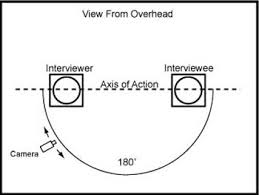
180 degree rule - The 180 degree rule is general guideline which directors will follow to ensure that ensures two characters/elements within the same scene should always have the same right/left relationship with each other. This is seen in a key scene in the film 'V for Vendetta' it is also used in interviews


Over the shoulder - A shot that gives us a character's point of view but that includes part of that character's shoulder or the side of the head in the shot. This is often seen in interviews or on program when two characters are in conversation.
Continuity editing – editing that directs the attention of the viewer, providing a smooth flow of dialogue or keeping the situation going or interrupting the viewer with the notion that they are watching a film.

 
Montage editing – this is the juxtaposition of a collection of shots designed to show the passing of time. The idea of a montage is to tell a long story in a short space of time therefore not boring the viewing audience. They keep the attention of the audience by putting it in with a motivational song or with comical imagery. We see this sort of montage take place in 'Rocky' where we see rocky in training.


Close up – This is where the talent is near the camera and is right in frame and so they are in full view of the audience this gets the audiences full attention.

Special effects – reference to visions and fantasies or dreams possible by lighting effects or imagery which is developed via computer.
Cross-cutting – This is when the editor makes the audience think that two scenes are happening at the same time a perfect example of this is silence of the lambs where we see the agent knocking on the door of the killer and all of the police another house. This gives the audience a scene of misbelieve.
Motivation – An editor can create motivation by having shots of a character dying and another shot of another character looking on at the death. Usually it is a popular character that dies or if they die at the start of the film you feel that the dead character was a big part of the main characters life.

Providing and withholding information – withholding information can develop and increase the tension and keep your audience interested for example you see this lot in crime dramas because this is how these shows work. When a person is killed you are made to keep guessing as the police work out who done the crime. Despite there being a new form of antihero in crime dramas now the drama operates in a different way.